The short version
- Cervicogenic headaches start in the neck and have the strongest evidence for manipulation and neck exercise.
- Evidence for chiropractic care in migraine and tension-type headache is preliminary or mixed.
- A sudden, severe headache is an emergency, not a reason for an adjustment.
- Posture, sleep, stress and screen habits often play a part in recurring headaches.
What kinds of headaches are there?
Doctors split headaches into two groups. Primary headaches, such as migraine, tension-type and cluster headaches, are conditions in their own right. Secondary headaches are caused by something else, such as a neck problem, an injury, an infection or a medication.
The type matters because treatments and evidence differ. A chiropractor's role is mainly with headaches that involve the neck and surrounding muscles.
| Type | What it often feels like | Where chiropractic fits |
|---|---|---|
| Cervicogenic | One-sided pain from the neck or base of the skull toward the eye; worse with neck movement | Best research support for manipulation and neck exercise |
| Tension-type | Pressing or tight band around the head, often with tight neck and shoulder muscles | Mixed evidence; exercise and soft tissue care may help some people |
| Migraine | Throbbing pain, often with nausea and light or sound sensitivity | Preliminary evidence; best managed with a physician |
| Cluster | Severe pain around one eye in repeated attacks | Needs medical care |
What causes headaches that start in the neck?
A cervicogenic headache is pain felt in the head that actually comes from the joints, discs or muscles of the upper neck. The nerves of the upper neck share pathways with nerves of the head, so irritation in one can be felt in the other.
Common contributors include:
- Long hours with the head pushed forward at a screen (see posture and tech neck)
- Stiff joints in the upper neck
- Tight muscles at the base of the skull and across the shoulders
- A past neck injury, such as whiplash from a car accident
- Poor sleep position or an unsupportive pillow
Stress, dehydration, skipped meals and poor sleep can add to almost any type of headache.
How do we evaluate headaches at our clinic?
We start with a detailed history: when the headaches began, where they start, how long they last, what triggers them and what helps. We ask specific questions to screen for warning signs that point to a physician or emergency room instead.
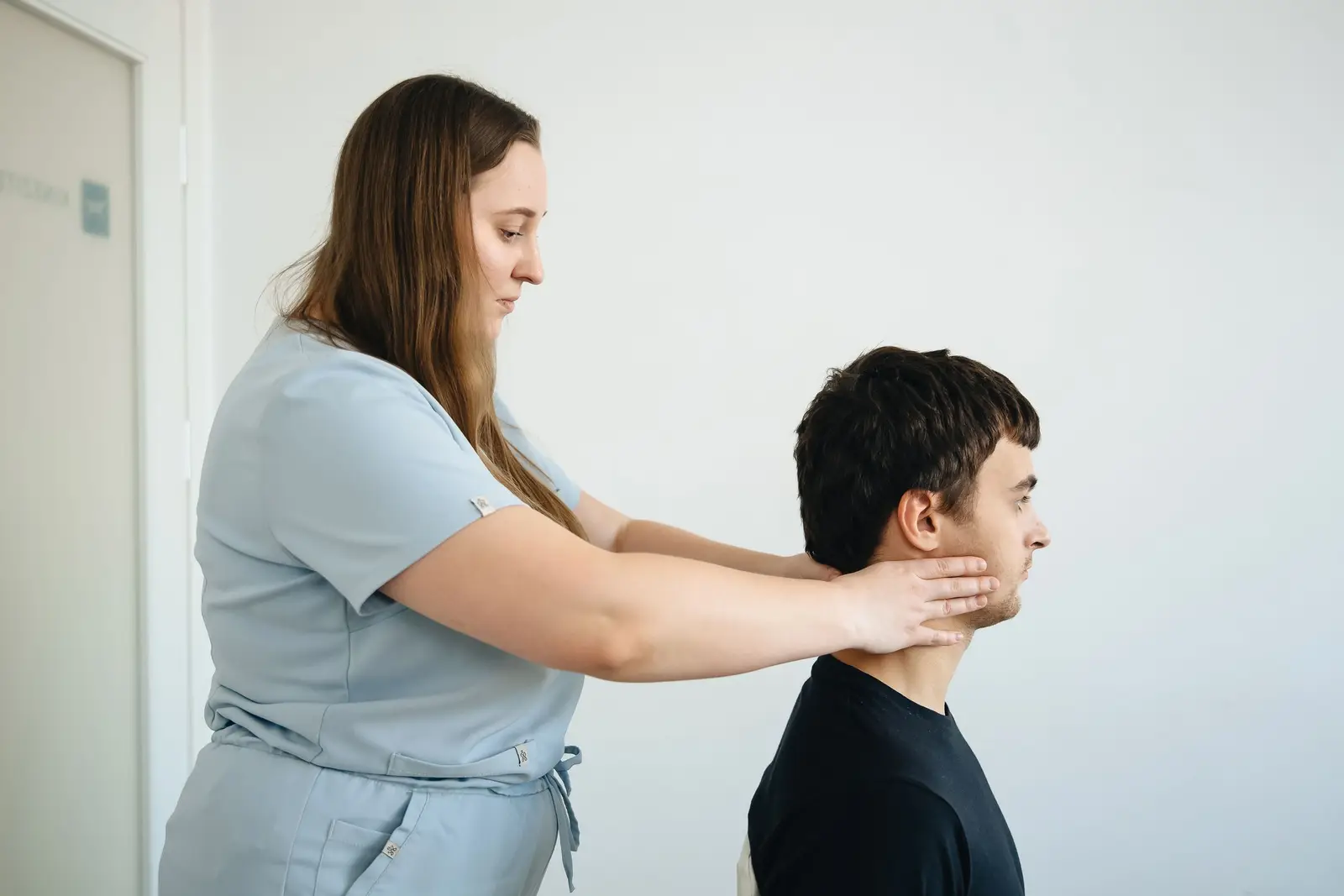
The physical exam checks neck motion, posture, tender points in the neck and shoulder muscles, and a basic neurological screen. If your headaches follow an injury or your exam suggests a structural problem, X-rays may be taken when needed. We review what we find and recommend a plan, or a referral when your headaches look like something outside our scope.
Which treatments may help?
When the neck or muscles play a role, a combination of approaches usually works better than one alone. Results vary.
- Chiropractic adjustments: manipulation or gentle mobilization of stiff joints in the neck and upper back.
- Physical rehab: deep neck flexor and upper back strengthening, which research supports for cervicogenic headache.
- Medical massage: soft tissue and trigger point work for tight neck and shoulder muscles.
- Dry needling: thin needles placed into tight bands of muscle that may refer pain to the head.
What does the research show?
The evidence depends on headache type. A Cochrane review of physical treatments found that both spinal manipulation and low-intensity neck exercise reduced cervicogenic headache compared with no treatment. A later review summarized by the National Center for Complementary and Integrative Health found manipulation may reduce how often and how intensely cervicogenic headaches occur.
For migraine, one review found manipulation may reduce migraine days and pain, but the reviewers called the results preliminary. For tension-type headache the picture is mixed, and adding manipulation to massage did not help episodic tension-type headache in the Cochrane review. NCCIH's overall summary is that evidence for manipulation across headache types is too inconsistent for firm conclusions.
What can I do at home to prevent headaches?
- Keep a headache diary with timing, triggers, sleep, food and stress.
- Set your screen at eye level and take a short break every 30 to 45 minutes.
- Practice chin tucks and shoulder blade squeezes from your plan.
- Drink water through the day and keep regular meal and sleep times.
- Use a pillow that keeps your neck level when you sleep.
For desk setup ideas, see our desk posture and spine tips. If your headaches come with ongoing neck pain, that page explains how we approach both together.
When to see a doctor or go to the ER instead
- A sudden, severe headache that reaches full strength within about a minute (a thunderclap headache) needs emergency care.
- A headache with fever and a stiff neck needs emergency care, as it can signal meningitis.
- A headache with weakness, numbness, confusion, trouble speaking, vision changes or fainting can be a stroke; call 911.
- A headache after a head injury, or a new headache pattern that keeps getting worse over days or weeks, needs prompt medical evaluation.
- A new, constant headache in an adult over 50, or one with weight loss you cannot explain, should be checked by a physician.
If you think you are having a medical emergency, call 911.
How we treat it
Frequently asked questions
Cervicogenic headaches usually affect one side, start at the back of the head or neck, and spread toward the forehead or eye. They often come with neck stiffness and get worse with certain neck movements or sustained postures. An exam is needed to confirm this, since migraine and tension-type headaches can also involve neck pain.
Some studies suggest spinal manipulation may reduce migraine days and intensity, but reviewers consider those results preliminary. Migraine is a neurological condition, and many people do best with a physician involved. We can work alongside your doctor on neck and muscle contributors, posture and exercise.
Mild soreness or a brief headache after treatment is a common side effect. Very rarely, neck manipulation has been linked to tears in neck arteries, though whether it causes them is debated. We screen for warning signs before treating, and we can use gentler techniques such as mobilization and soft tissue work.
Go to an emergency room for a sudden, severe headache that peaks within about a minute, a headache with fever and a stiff neck, or a headache with weakness, confusion, trouble speaking, vision loss or fainting. A headache after a head injury also needs urgent evaluation.
Sources
- NINDS: Headache (opens in a new tab)
- NCCIH: Headaches, what you need to know (opens in a new tab)
- NCCIH: Spinal manipulation, what you need to know (opens in a new tab)
- Cochrane: Non-invasive physical treatments for chronic or recurrent headache (opens in a new tab)
- MedlinePlus: Headache (opens in a new tab)

This page is general education, not medical advice. It cannot replace an exam. Results from any treatment vary from person to person.