The short version
- Rotator cuff irritation often hurts at the front or side of the shoulder, with overhead reaching and at night.
- Frozen shoulder moves through freezing, frozen and thawing stages and can take a year or more to resolve.
- Neck problems can refer pain to the shoulder, so a good exam checks both.
- Physical therapy and exercise are first-line care for rotator cuff pain and frozen shoulder, per AAOS.
- Left shoulder or arm pain with chest pressure or shortness of breath can be a heart attack; call 911.
What causes shoulder pain?
The shoulder is the most mobile joint in the body, which also makes it easy to overload. Most shoulder pain falls into a few groups.
| Cause | What is going on | Typical signs |
|---|---|---|
| Rotator cuff tendinitis or impingement | Irritated cuff tendons and bursa under the top of the shoulder | Pain lifting the arm overhead and at night |
| Rotator cuff tear | Partial or full tear of a cuff tendon | Pain plus weakness lifting or rotating the arm |
| Frozen shoulder | Thickened, tight joint capsule | Slow loss of motion in every direction |
| Arthritis | Worn cartilage in the joint | Deep ache, stiffness, grinding |
| Referred pain from the neck | Irritated nerve or joint in the neck | Pain spreading down the arm, tingling |
Who gets these problems?
AAOS notes that rotator cuff irritation is common in people who swim, play tennis or volleyball, or work overhead, like painters. Frozen shoulder most often affects people ages 40 to 60, more often women, and it is much more common in people with diabetes or thyroid disease. It can also follow a period when the arm was kept still after surgery or injury.
Desk posture matters too. Long hours with the shoulders rounded forward can change how the shoulder blade moves. Our page on posture and tech neck covers that link.
What symptoms point to which problem?
Rotator cuff pain usually sits at the front or side of the shoulder. It hurts most when reaching overhead, putting on a jacket or lying on that side at night. Weakness lifting the arm suggests a tear.
Frozen shoulder starts with a growing ache, then stiffness takes over. You may not be able to reach behind your back or overhead, even with help. AAOS describes three stages: freezing (6 weeks to 9 months), frozen (4 to 6 months) and thawing (6 months to 2 years).
Pain that starts in the neck and travels past the elbow, especially with tingling, often comes from the neck rather than the shoulder.
How do we evaluate shoulder pain?
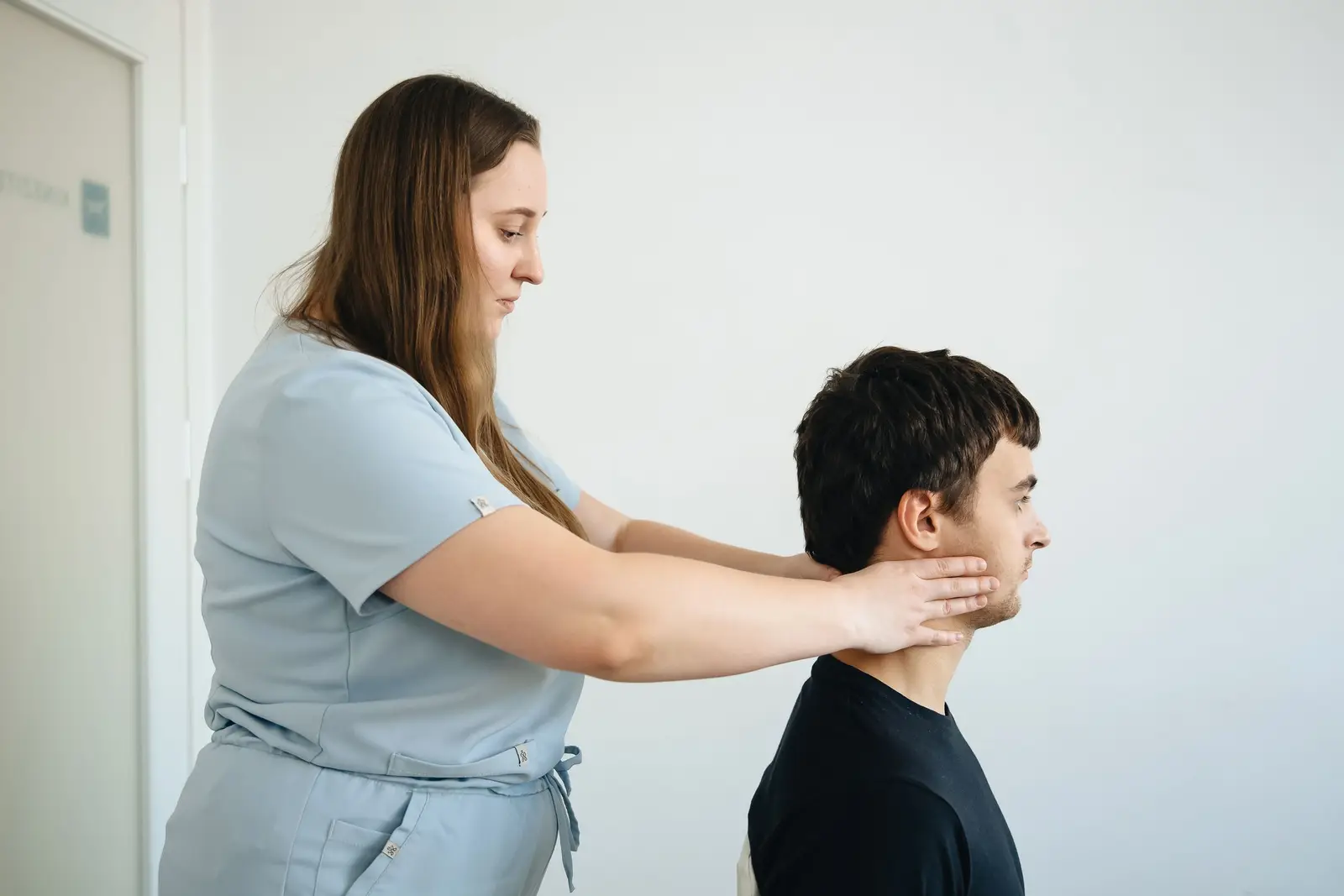
We start with your history: what you do for work and play, when the pain started, whether there was an injury, and what movements hurt. The exam checks active and passive range of motion, rotator cuff strength, special tests for impingement and tears, and how your shoulder blade moves.
We always screen the neck, because a pinched nerve can mimic shoulder pain. X-rays are taken when arthritis, a bone spur or an old injury is suspected. If the exam suggests a significant tear, we refer you for an MRI or to an orthopedic surgeon.
What treatments help shoulder pain?
AAOS lists physical therapy, starting with stretching and then strengthening, as the main nonsurgical treatment for rotator cuff tendinitis. For frozen shoulder, flexibility-focused therapy is the primary treatment. Recovery often takes weeks to months, and results vary.
- Physical rehab: Range-of-motion work, rotator cuff and shoulder blade strengthening, and a gradual return to overhead tasks.
- Chiropractic adjustments: Mobilizing the upper back, ribs and neck can help when stiffness there changes how the shoulder moves.
- Medical massage: Eases tight muscles around the shoulder and upper back.
- Soft tissue scraping: Instrument-assisted work on tight tissue. Evidence is limited, so we pair it with exercise.
- Dry needling: Targets tender trigger points in muscles around the shoulder blade. Some studies suggest short-term pain relief.
- Medical pain management: When necessary, injections provided by our physician, Dr. Hector Molina, MD. AAOS notes a steroid injection may help rotator cuff pain that does not respond to therapy.
What can you do at home?
- Keep it moving. Gentle pendulum swings and wall slides within comfort help prevent stiffness.
- Change, do not stop. Limit overhead reaching for a while instead of resting the arm completely.
- Sleep smart. Sleep on the other side with a pillow under the sore arm, or propped up a little.
- Set up your workspace. Keep your keyboard and mouse close so your elbows stay near your sides.
- Ice or heat. Ice can calm a flare; heat before stretching can make motion easier.
When should you see an orthopedic surgeon or go to the ER?
Go to the ER for a deformed shoulder, an injury you cannot move at all, or shoulder pain with signs of a heart attack. See an orthopedic surgeon if you suddenly cannot lift your arm after a fall or lift, if weakness keeps getting worse, or if pain does not improve after several months of good nonsurgical care.
Golfers and pickleball players with shoulder pain often have elbow trouble too. See our page on tennis and golfer's elbow and our sports injuries overview.
When to see a doctor or go to the ER instead
- Shoulder, jaw or left arm pain with chest pressure, sweating or shortness of breath can be a heart attack; call 911.
- A shoulder that looks deformed or that you cannot move after a fall needs emergency care for a dislocation or fracture.
- Sudden inability to lift your arm after an injury needs prompt evaluation for a rotator cuff tear.
- A hot, red, swollen shoulder with fever needs same-day medical care to rule out infection.
If you think you are having a medical emergency, call 911.
How we treat it
Frequently asked questions
Night pain is a classic feature of rotator cuff irritation and frozen shoulder. Lying on the sore side compresses the area, and lying flat changes how the arm hangs. Sleeping on the other side with a pillow hugged against your chest, or propped slightly upright, often helps.
Care can help you keep and slowly regain motion while the condition runs its course. AAOS lists physical therapy focused on flexibility as the main treatment. We use gentle stretching, rehab and soft tissue work, and we refer to a physician if injections or other medical care may help.
It can be. Pain that starts in the neck, spreads past the elbow, or comes with tingling in the hand often points to a pinched nerve in the neck rather than the shoulder joint. A good exam tests both areas. Our neck pain page explains more.
Not always. AAOS reports that nonsurgical care relieves pain and improves function for most people with rotator cuff tears. Surgery is more often discussed for a tear from a recent injury, a large tear with major weakness, very active people or overhead workers, or pain that lasts 6 to 12 months despite good care. An orthopedic surgeon makes that call.
Sources

This page is general education, not medical advice. It cannot replace an exam. Results from any treatment vary from person to person.