The short version
- Shockwave therapy uses pulses of acoustic energy aimed at a painful tendon or fascia; nothing is cut or injected.
- The best evidence is for long-lasting plantar fasciitis; evidence for other tendon problems is promising but less certain.
- It is usually given over several short sessions and works best alongside exercise and load changes.
- It is not used over a pregnancy, a tumor, an infection, open growth plates or in people with bleeding disorders without careful review.
What is shockwave therapy?
Shockwave therapy is a treatment that sends short, strong pulses of sound energy through the skin into a painful tendon, ligament or band of tissue. The research name is extracorporeal shockwave therapy, or ESWT. "Extracorporeal" simply means the energy starts outside the body. Our previous website called it soundwave therapy.
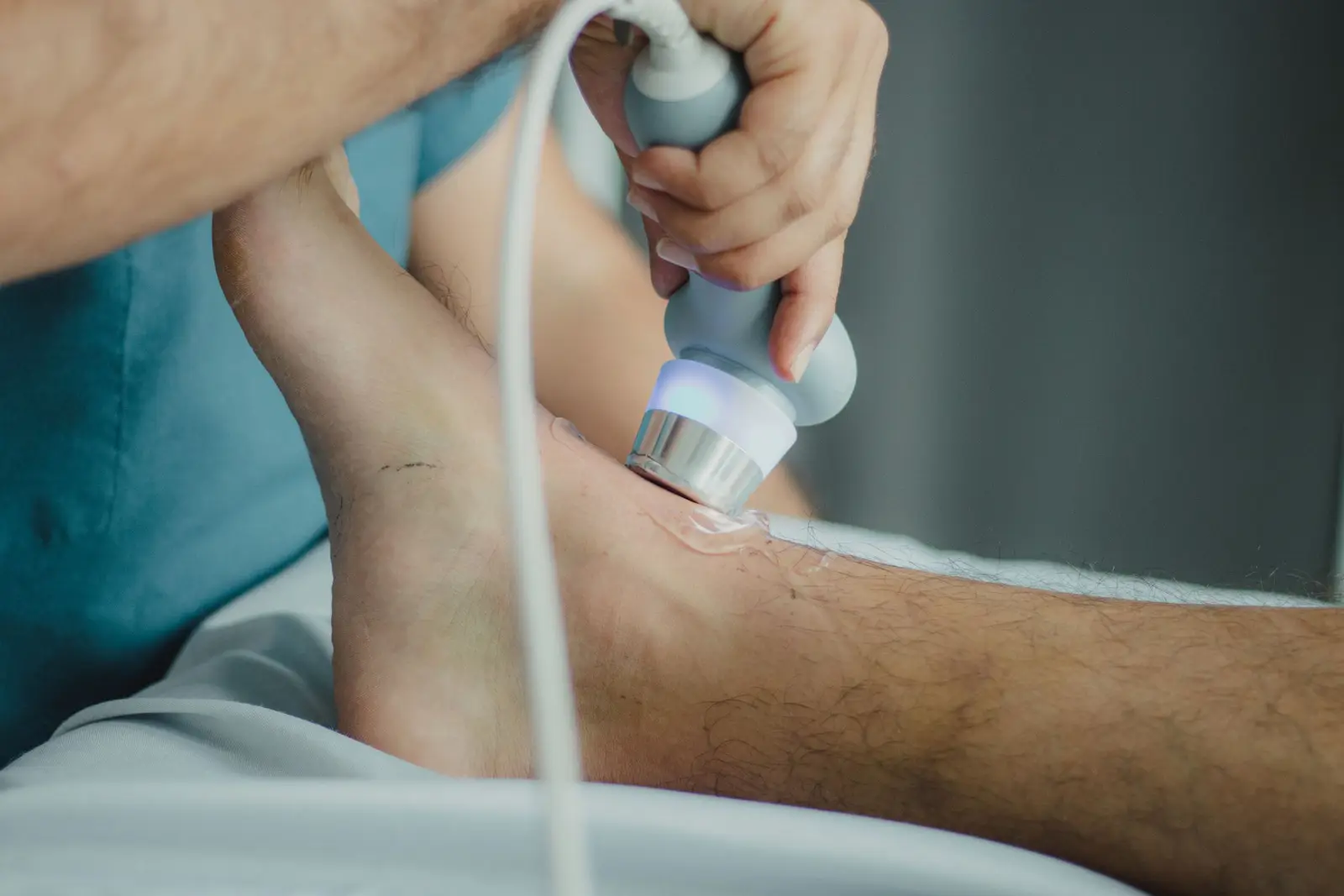
There are two main types. Focused shockwave concentrates energy at a set depth. Radial shockwave spreads energy outward from the applicator and stays more superficial. Both are delivered with a handheld device pressed against the skin with a layer of gel.
How is it thought to work?
Researchers believe the pulses trigger a healing response in tissue that has stalled. Proposed effects include new blood vessel growth, changes in how pain nerves fire, and breakup of calcium deposits in some shoulder tendons. These ideas come mostly from lab and animal work. How much each one matters in people is still being studied.
What does the research show?
The evidence is strongest for plantar fasciitis that has lasted months. A 2024 review of 11 randomized trials found that both focused and radial shockwave reduced heel pain and were well tolerated. Other reviews are more cautious and find that shockwave beats sham treatment but performs about the same as some other active treatments.
| Problem | What research suggests | Strength of evidence |
|---|---|---|
| Long-lasting plantar fasciitis | Pain relief compared with sham | Moderate, with mixed study quality |
| Calcific shoulder tendinitis | Can reduce pain and calcium deposits | Moderate |
| Tennis elbow | Results are mixed | Low to moderate |
| Achilles and patellar tendon pain | Some positive trials | Low |
| Low back or neck pain | Few good studies | Very limited |
Results vary from person to person. Shockwave is rarely a first treatment. It is usually considered after a few months of stretching, strengthening, footwear changes and rest from aggravating activity have not been enough. You can read more about heel pain on our plantar fasciitis page and about elbow tendon pain on our tennis and golfer's elbow page.
Who may be a candidate?
You may be a candidate if you have a tendon or fascia problem that has lasted longer than about three months and has not improved with standard care. Common examples are heel pain, elbow pain from gripping, and some kinds of shoulder pain.
An exam comes first. We check that the pain really comes from the tendon or fascia and not from a nerve, a joint problem or a stress fracture, which need different care.
What happens during a session in Dallas?
A typical visit is short. The clinician finds the most tender area, applies gel, and moves the applicator over the spot while delivering a set number of pulses.
- We review your history, medications and any reasons the treatment should be avoided.
- We locate the sore tissue by touch and movement testing.
- Pulses are delivered for several minutes, starting gently and adjusting to your comfort.
- You go back to normal daily activity, usually avoiding hard training on that area for a day or two.
Expect a strong tapping sensation. Temporary redness, soreness, swelling or small bruises are the most common side effects reported in studies. Serious problems are uncommon when the device is used as recommended.
How does shockwave fit with the rest of your care?
Shockwave works best as one part of a plan, not as the whole plan. Tendons respond to load, so a gradual strengthening program usually matters as much as the device. We often pair it with physical rehab and, for some people, dry needling or laser therapy.
When is shockwave not the right choice?
Some problems need a different path. Sudden severe pain after a fall, a heel that hurts at rest and at night, numbness that spreads, or a joint that is hot and swollen should be checked by a physician first. If your symptoms point to a sports injury that needs imaging or a specialist, we will say so.
Conditions this is used for
Frequently asked questions
Most people feel strong tapping and some discomfort during the session, especially over the most tender spot. The intensity can be adjusted as you go. Some soreness, redness or mild bruising for a day or two afterward is common and usually settles on its own. Tell the clinician right away if the discomfort feels sharp or wrong.
Studies often use about three to five sessions spaced roughly a week apart, but protocols vary a lot. Your plan depends on the problem being treated, how long you have had it and how your tissue responds. Any change in pain tends to build gradually over the weeks after treatment rather than right away.
Yes. Our previous website called it soundwave therapy. Both names describe the same idea: pulses of acoustic energy delivered through a handheld applicator to a painful tendon or band of tissue. The technical name in research is extracorporeal shockwave therapy, often shortened to ESWT.
Sometimes it is tried before those options, especially for long-standing heel pain that has not improved with stretching, supportive shoes and activity changes. It does not help everyone, and some reviews find it performs about the same as other active treatments. Your clinician can talk through how it compares for your specific problem.
It should not be aimed over a pregnancy, a known tumor, an area of infection or open growth plates in children. People with bleeding disorders, those on blood thinners, and people with implanted devices near the treatment area need careful review first. Recent steroid injections in the same spot are also a reason to wait and discuss timing.
Sources
- Lippi et al. 2024: ESWT for plantar fasciopathy, systematic review and meta-analysis (PubMed) (opens in a new tab)
- Extracorporeal shock wave therapy: an update (PMC review) (opens in a new tab)
- Shockwave therapy for musculoskeletal pain: mechanisms, applications and safety (PMC narrative review) (opens in a new tab)

This page is general education, not medical advice. It cannot replace an exam. Results from any treatment vary from person to person.